Designing for Outcomes
How clear principles lead to better design decisions. Two months inside Numerade — establishing product-specific design principles, governing the mobile branch of the design system, and giving designers, engineers, and PMs a shared vocabulary for the decisions that compound across an evolving ecosystem.
• Principles before components. A team that
already has patterns doesn't need more patterns — it needs a
shared way to decide between them. Product-specific principles
become that contract.
• Anchor the principles in four questions.
What is the system for? Why does that matter? How will the
system achieve it? Who is it for? Anything that can't anchor
to those four answers doesn't join the system.
• Wire the principles into the design system.
Slides die in inboxes. Principles only stick when they govern
real decisions inside the component library, the documentation,
and the review process.
• Counter-bullet: principles are easy to
write, hard to defend. They only earn their keep when they
actually change a decision — otherwise they're slogans.
Table of contents.
An ecosystem that had grown faster than its principles.
Numerade is an education platform built to make STEM learning more accessible. By the time this work started, the product had evolved across web and mobile — and the visual language and interaction patterns had drifted along the way. Two user groups mattered most for the mobile work: anonymous users running quick lookups through Snap Solve, and registered users — students and educators — relying on personalized study paths. They were both being served by the same fragmented experience.
The diagnosis came in three layers: user confusion from inconsistent navigation patterns hampered the actual learning experience; reduced trust followed — when visual and interaction harmony fall apart, brand credibility falls with it; and limited scalability meant the team couldn't move quickly on new features, platforms, or audience needs in native mobile environments. Each problem reinforced the next.
Principles as a decision contract — not a slide deck.
The team didn't need more patterns; it needed a shared way to decide between patterns. Product-specific design principles became the contract: a North Star for evaluating trade-offs, bridging the gap between designers, engineers, and PMs without re-running the same debate every sprint.
“To empower students and educators through human-centered, inclusive, and adaptable design. Every interaction with Numerade should be accessible, authentic, and impactful.”
Three moves that made the principles stick.
A principle is only as useful as the decision it changes. Getting the principles to actually change decisions took three deliberate moves — in this order, with each one earning the next.
-
01
Map the user ecosystem before changing it
I started by mapping the user ecosystem — separating anonymous Snap Solve users from registered students and educators — and auditing the existing experience against both. The picture came back consistently: inconsistent navigation patterns, fragmented visual elements, and weak mobile support. The audit became the brief for what principles had to govern, and in what order.
-
02
Answer four foundational questions, in order
Before naming any principle, the team agreed on four questions and answered them together: what is the system's goal? why is that goal important? how will the system help achieve it? who is it for? Anything that couldn't anchor back to those four answers wasn't part of the system — and didn't get added to the design vocabulary.
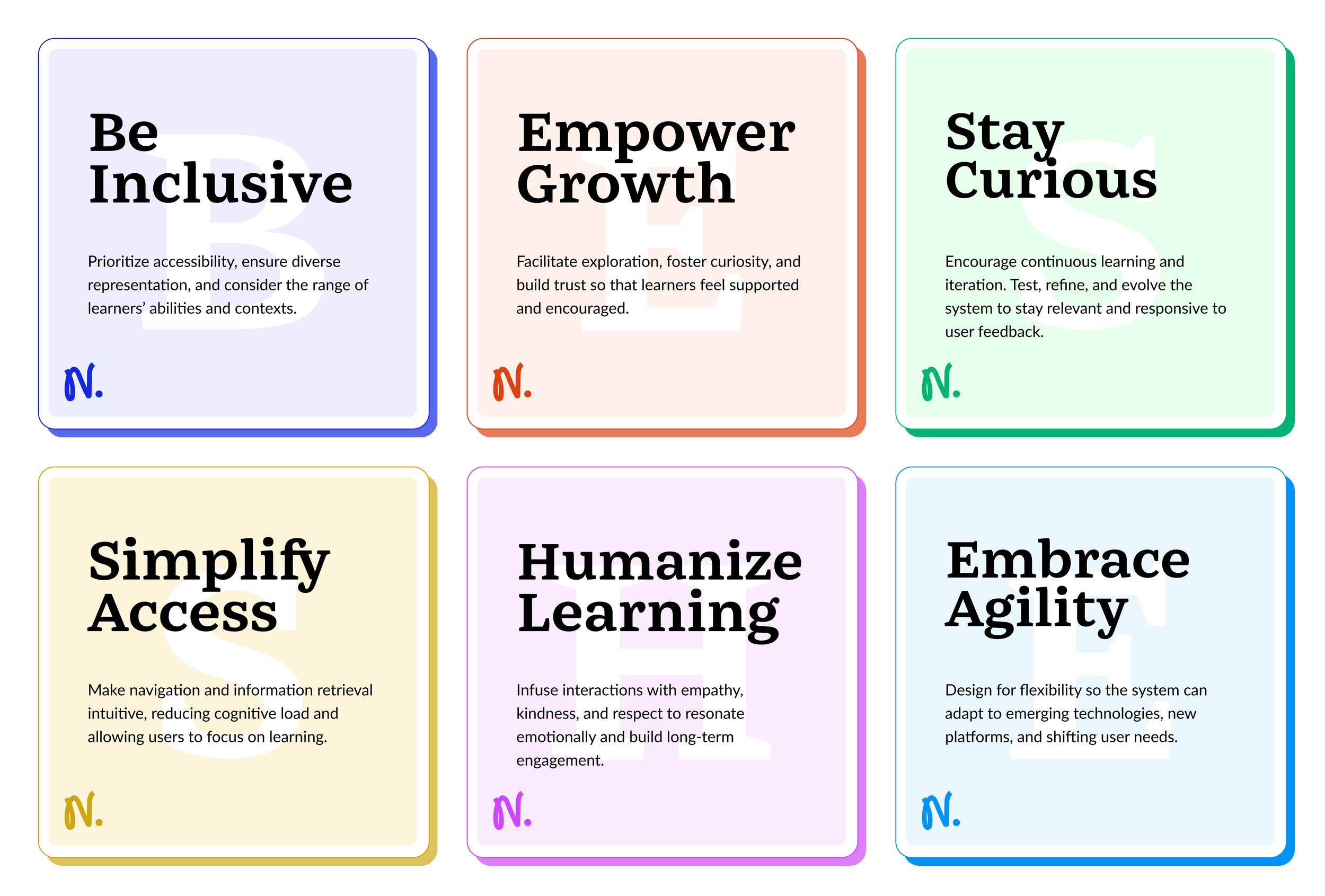
[NEEDS: the actual product-specific design principles that came out of this exercise — 3–5 short names with one-line definitions. Without them, this step reads as method without payoff. With them, this becomes the most-quotable part of the post.]
-
03
Wire the principles into the design system
The principles weren't a slide deck. They lived inside the mobile branch of the design system — alongside reusable, accessible components, integrated style guides, and the feedback loops and governance structures that kept the system from drifting again. Strategic priorities followed from the principles directly: reinforce Snap Solve patterns on the high-value flows; smooth, brand-consistent onboarding & engagement; and cross-tool consistency across every UI pattern users encountered.
When principles fail to land.
The honest part: principles only stick when they cost someone something. The first time a PM ships a feature that doesn't pass the four foundational questions, the team either escalates and earns the principle — or lets it slide and devalues the next one. We let it slide more often than I want to admit. The other failure mode is the abstraction trap: a principle written too high ("be authentic", "be inclusive") governs everything and disqualifies nothing. The ones that earned their keep named a tradeoff a designer could lose concretely — "inform versus empower", "consistency versus surprise" — so the review conversation had somewhere to land that wasn't taste.
Principles before components. The team didn't need more patterns — it needed a shared way to decide between patterns. Product-specific design principles became the contract: a North Star for evaluating trade-offs, bridging the gap between designers, engineers, and PMs without re-running the same debate every sprint.
Principles are a living document.
The work landed on four outcomes the team could point at, even before the next quarter's metrics rolled in: consistent brand expression across every touchpoint, improved efficiency and scalability from formalised decision-making and reusable components, inclusive and accessible solutions baked into the system instead of bolted on, and enhanced cross-functional alignment through a shared design vocabulary.
The plan from here: solicit user feedback to refine and prioritise system iterations, revisit the principles as user needs and technologies evolve, and continue championing them as the foundation for consistent product experiences across the whole Numerade ecosystem. Principles only stay useful if they stay contested — the moment they become uncontroversial, they've stopped governing anything.
“Components without principles are just opinions in code. Principles without components are slogans. The trick is to put them in the same drawer — and let the design decisions that come after lean on both.”